
Healthcare M&A Market Overview: First Quarter 2026
Healthcare mergers and acquisitions entered Q1 2026 in a state of disciplined momentum. Provider-sector deal volume remained broadly stable from prior-year levels, while the hospital and health system segment recorded its highest transaction count since early 2020. Across the middle market, buyers continued to reward quality assets and penalize revenue concentration risk, compressing median EBITDA multiples modestly while sustaining premium pricing for platform-grade assets with durable margins and diversified revenue.
Against this backdrop, Acuvance Coker continues to see sustained transaction interest across the specialty care, physician services, behavioral health, and post-acute segments that define our client base. The themes shaping Q1 2026 are ones our advisory practice navigates every day: disciplined Quality of Earnings processes, defensible normalization, and strategic positioning that withstands heightened buyer scrutiny.
Market Conditions and Deal Volume
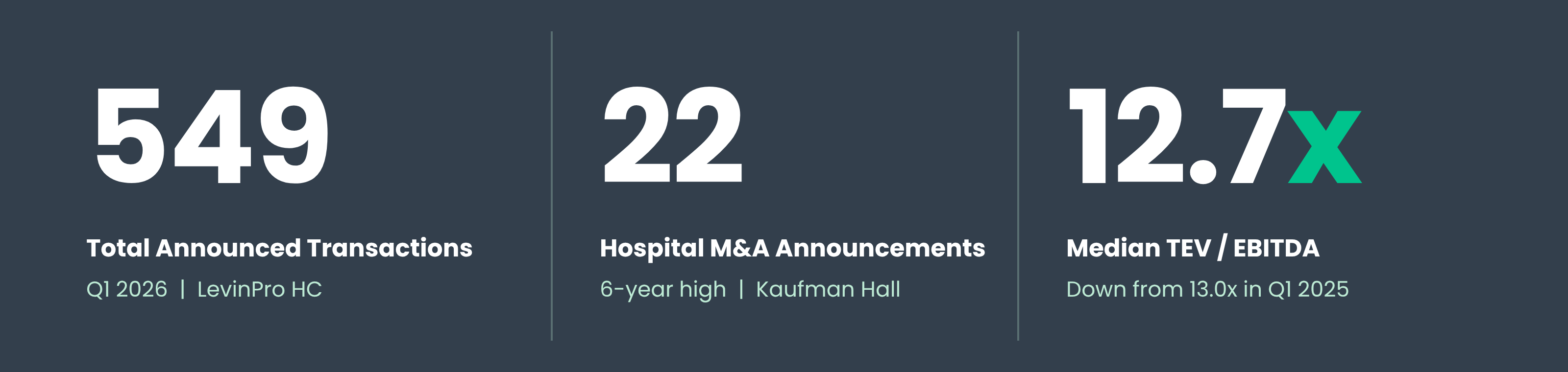
Across all provider sectors, 549 publicly announced healthcare transactions were recorded in Q1 2026, essentially flat compared to 542 deals in Q4 2025 and down less than 1% year-over-year. While the quarter-to-quarter stability may appear unremarkable, the current run rate remains historically elevated relative to pre-pandemic deal flow.
On a last-twelve-months basis through Q1 2026, healthcare M&A volume declined approximately 19% year-over-year, yet the sector continues to represent roughly 6.9% of all cross-sector transaction activity - underscoring durable institutional capital interest in healthcare. The contraction reflects buyer discipline and heightened selectivity, not a withdrawal of capital.
"Although healthcare deal volume has essentially flatlined these past few years, it's still historically very high, especially compared with pre-COVID levels. Demand for organizations offering AI-enabled technology or those in the outpatient care space continues to drive activity." - Dylan Sammut, Healthcare Editor, Irving Levin Associates (April 2026)
Hospital and health system transactions told a distinctly different story. Kaufman Hall recorded 22 M&A transaction announcements in Q1 2026, the most within that segment since early 2020, with combined transacted revenue of $14.5 billion - the highest level recorded by the firm since it began tracking hospital deals in 2018. The average annual revenue of the smaller transaction party was $657 million, the second highest since 2018. Activity was boosted by a trio of megamergers, most notably the proposed combination of California-based Sutter Health and Minnesota-based Allina Health, which would create a system generating approximately $26 billion in annual revenue.
Portfolio rationalization and divestitures emerged as a defining theme of the quarter. More than two-thirds of hospital transaction announcements in Q1 2026 involved a divestiture, compared to 45.6% of all transactions in full-year 2025, as large and national health systems shed underperforming or non-core facilities to redirect capital toward strategic investment.
Valuation Multiples and Buyer Discipline
Multiple compression continued its measured trend across most segments. Median TEV/EBITDA for healthcare services transactions declined to 12.7x in Q1 2026, down from 13.0x in Q1 2025 and 14.9x in Q1 2024. The TEV/Revenue multiple fell to 3.04x, the lowest level in the past four years, as buyers prioritized earnings quality over gross revenue scale and applied greater scrutiny to add-back adjustments.
The compression is not uniform. Platform-grade assets with demonstrated operating leverage and reimbursement stability continue to command top-quartile pricing. Practices generating $5 million or more in normalized EBITDA consistently achieve multiples in the 10x to 12x range, while smaller add-on acquisitions transact in the mid- to high-single-digit range. This spread between platform and add-on multiples has widened, reinforcing the value that a well-prepared, independently verified Quality of Earnings process brings to middle market sellers.

Seller-side valuation expectations have not fully reset in all segments, creating friction in select negotiations. Earnout provisions, rollover equity, and option-to-acquire structures are increasingly common deal mechanics, particularly in physician practice management transactions where physician retention and post-close performance drive value.
"Healthcare M&A continues to draw strong capital interest, but the threshold for premium valuations has risen meaningfully. Buyers are prioritizing platforms with demonstrated operating leverage, defensible reimbursement models, and clear strategic fit." - Brad Scharfenberg, Vice President, PCE Investment Bankers (Q1 2026)
Strategic Acquirers and Private Equity Activity
Strategic buyers accounted for approximately 89% of healthcare M&A transactions (881 deals) in the LTM period through Q1 2026, concentrating on diagnostics, life sciences, and technology-enabled care delivery. Notable large-cap strategic transactions included Abbott's $23.5 billion acquisition of Exact Sciences and Waters Corporation's $18.8 billion purchase of BD's Biosciences and Diagnostics Solutions segment.
Financial sponsors accounted for approximately 11% of deal volume (109 deals) in the LTM period but remained the dominant force within the middle market physician practice segment. Private equity firms executed at least 1,029 tracked healthcare deals in the U.S. in 2025, with outpatient care ranking as the third-busiest subsector by deal volume. In Q1 2026, PE-backed activity included 79 publicly tracked physician practice transactions, concentrated in dermatology, cardiology, and orthopedics. Private equity represents more than 90% of all physician practice M&A transactions in that subsector.
PE sponsors are prioritizing platforms with centralized management infrastructure, documented compliance protocols, diversified payor mix, and physician retention structures. Assets that enter a competitive sale process without those attributes already in place face a meaningful discount relative to similarly sized peers that have prepared.
Mid-market private equity faces new competitive pressure from larger funds extending into smaller deal sizes to achieve higher returns. This dynamic is creating accelerated deal timelines and intensifying competition for quality assets - reinforcing the importance of a well-structured, competitive transaction process over bilateral negotiation.
Subsector Highlights
Specialty Physician Practices
Cardiology and gastroenterology showed the most aggressive buyer competition in Q1 2026, with ophthalmology retina practices also generating sustained interest. Behavioral health remains a high-demand segment - AI adoption among behavioral health providers rose from 17% in 2024 to 27% in 2025, and platform operators are actively pursuing scale. Pain management, orthopedics, and chiropractic remain active subsectors for regional platform builds and tuck-in acquisitions.
Outpatient and Value-Based Care
The ongoing shift toward outpatient care continues to accelerate deal activity. Ambulatory surgery centers, home-based care platforms, and outpatient infusion remain well-positioned, commanding above-average multiples relative to broader healthcare services. Demographic trends, cost pressures, and patient preferences for outpatient settings have accelerated both portfolio rationalization by health systems and specialty expansion by PE-backed platforms.
Seniors Housing and Post-Acute
Seniors housing and care M&A activity remained elevated in Q1 2026, supported by strong demographic tailwinds and ongoing consolidation among regional operators. Well-operated facilities with stable census and manageable labor cost structures continue to attract consistent buyer interest from both strategic acquirers and PE-backed platforms.
Healthcare Technology and AI-Enabled Care
eHealth transactions increased to 63 deals in Q1 2026, with activity concentrated particularly among companies offering AI-driven services. Universal Health Services' $835 million acquisition of Talkspace represented the largest single services transaction of the quarter, reflecting the convergence of telebehavioral health scale with traditional inpatient behavioral platforms. Revenue cycle management tools, workforce optimization platforms, and utilization management technology are among the most actively pursued targets.
Regulatory and Policy Considerations
Regulatory and legislative risk remains the primary headwind to healthcare M&A activity in 2026. Proactive buyers and sellers are accounting for the following dynamics in transaction structure and diligence scope.
- Policy Acceleration: The One Big Beautiful Bill Act introduced Medicaid funding reductions scheduled to take effect beginning in 2027. The approaching timeline has spurred proactive strategic partnership activity among independent health systems seeking to strengthen scale and access to care ahead of those changes - contributing to the surge in hospital transaction announcements in Q1 2026.
- Antitrust Climate: Ongoing FTC and DOJ scrutiny of private equity consolidation, physician practice aggregation, and cross-market health system mergers continues to shape deal structures. Buyers are increasingly relying on joint ventures, targeted asset realignments, and partnership structures to advance strategic objectives while managing antitrust exposure.
- Reimbursement Shifts: The renewed debate over site-neutral reimbursement illustrates the urgency for hospital operators and ambulatory care providers to realign their revenue mix ahead of potential pricing policy changes. Assets with significant hospital outpatient department revenue concentration face elevated diligence scrutiny from financially disciplined buyers.
- Earnings Quality Scrutiny: EBITDA add-back scrutiny has intensified, especially surrounding pro forma concepts. Buyers in 2025 and into 2026 are challenging normalization adjustments more aggressively than in prior market cycles, making independent, credible Quality of Earnings analysis increasingly critical for sellers seeking to support their adjusted earnings positions and for buyers seeking to validate acquisition assumptions.
Acuvance Coker Perspective
The Q1 2026 environment reflects a market in which preparation and credibility determine outcomes. The spread between well-prepared sellers and those entering a process without financial diligence discipline has never been wider from a valuation standpoint. The assets commanding top-quartile multiples share common attributes: independently verified normalized EBITDA, clean revenue recognition practices, diversified payor mix, and management infrastructure that can withstand buy-side scrutiny.
Acuvance Coker has advised on more than 200 healthcare transactions across buy-side and sell-side engagements, with deep expertise in Quality of Earnings, Quality of Revenue, and Net Working Capital analyses for middle market healthcare businesses. Our clients benefit from that transaction depth and from advisors who understand the operational and clinical context that shapes how sophisticated buyers underwrite healthcare assets.
Whether you are preparing for a sale process, evaluating an acquisition target, or navigating a private equity partnership transaction, Acuvance Coker brings the sector expertise and transaction experience to achieve the best possible outcome across the full spectrum of healthcare provider services.
Key areas where Acuvance Coker adds value in transactions:
- Quality of Earnings (QoE): EBITDA normalization, add-back substantiation, and diligence-ready financial presentation for buy-side and sell-side mandates
- Quality of Revenue (QoR): Payor mix assessment, billing compliance review, revenue cycle integrity, and reimbursement sustainability analysis
- Net Working Capital (NWC): Working capital peg analysis, locked-box mechanics, and peg negotiation support
- Pre-Transaction Readiness: Financial diligence preparation and process positioning for physician practice owners and healthcare executives
- Strategic Advisory: Deal structuring, transaction process management, and buyer outreach across PE-sponsored and strategic transactions
Outlook for the Remainder of 2026
The conditions supporting a measured pickup in healthcare M&A activity through the remainder of 2026 remain in place. Stabilizing interest rates, improving financing conditions, and the pressure on PE sponsors to deploy a significant backlog of uninvested capital are expected to support increased deal flow, particularly in the second half of the year.
Deal value is expected to continue rising as the market shifts toward fewer, larger, higher-quality transactions, even as volume growth remains modest. Strategic consolidation should accelerate in fragmented specialty subsectors as both corporate acquirers and sponsors pursue platform scale. The reopening of the mid-market IPO market - evidenced by the public debuts of digital health companies in 2025 - is beginning to provide alternative exit paths that may further stimulate activity.
For practice owners and healthcare executives considering a transaction in 2026, the market window is favorable. However, preparation separates average outcomes from exceptional ones. Buyers bring more sophisticated diligence capabilities and information access than at any prior point in the market cycle. Sellers who have anticipated that scrutiny and addressed it before the process begins consistently achieve better outcomes.
Preparing for a Transaction in 2026?
Our financial due diligence team has supported more than 200 healthcare transactions. Let's talk about how to position your organization for buyer scrutiny.
Talk With Our Financial Due Diligence Team
Sources: LevinPro HC / Irving Levin Associates Q1 2026 Healthcare M&A Deal Volume Report (April 15, 2026); Kaufman Hall M&A Quarterly Activity Report Q1 2026 (April 2026); PCE Investment Bankers Healthcare M&A Update Q1 2026; PwC Health Services Deals 2026 Outlook; Sikich Q1 2026 Healthcare M&A Market Update; FOCUS Investment Banking Physician Practice M&A Multiples and Healthcare EBITDA Multiples (2026); Fierce Healthcare / Advisory Board reporting on Kaufman Hall Q1 2026 data (April 2026). All data is as of Q1 2026 unless otherwise noted. This overview is intended for general informational purposes and does not constitute legal, financial, or investment advice.
